Transmission Mechanism and Durability of Manual Adjustment Systems
Outdoor Manual Pergolas typically utilize a hand-crank mechanism paired with a high-precision gear transmission system to adjust the angle of the louvers. Some high-end or heavy-duty models also incorporate a worm gear transmission to enhance transmission stability and self-locking capabilities. This design allows the operator to drive the entire louver system with minimal torque, enabling the synchronized and smooth opening and closing of multiple blades. Furthermore, when operation ceases, the system maintains its current position, preventing any back-drift or displacement caused by gravity or wind forces.
In terms of materials, critical transmission components are predominantly crafted from stainless steel or high-strength alloy steel to ensure excellent corrosion resistance and wear resistance within long-term outdoor environments. The external structure and louvers are typically constructed from aluminum alloy and treated with a powder coating process, endowing the surface with superior weather resistance, UV protection, and oxidation resistance. Certain products also undergo rigorous salt spray and wind load testing to ensure structural stability, even in coastal or high-humidity environments.
Regarding supply chain and product delivery, specialized manufacturers—such as Shaoxing OLE Leisure Products Co., Ltd.—focus not only on producing high-quality outdoor products but also possess comprehensive supporting capabilities. They offer customized design services spanning a diverse range of product types—including wrought iron, wicker, and aluminum outdoor furniture—and extend their product lines to include outdoor shading structures (such as pergolas) and patio umbrellas, thereby meeting client demands for holistic outdoor space solutions. Concurrently, the company facilitates efficient and cost-effective global shipping via the ports of Ningbo or Shanghai. The standard production lead time is typically 35 to 60 days following order confirmation, while samples can be provided within approximately 15 days. Furthermore, by updating inventory lists on a monthly basis, the company ensures that clients have timely access to in-stock resources and competitive pricing advantages. This mature manufacturing and supply chain capability serves as a robust guarantee for both product durability and reliable delivery.
Overall, given that these manual structures lack motors and electronic components, they present fewer potential points of failure and feature relatively simple mechanical designs. Consequently, with proper maintenance, their service life typically extends to 5 to 10 years—or even longer—while incurring relatively low maintenance costs.
Smoothness of Manual Operation and Single-Person Usability
Given a sound design and high manufacturing precision, the opening and closing process of an Outdoor Manual Pergola is typically remarkably smooth. Its gear system undergoes precision machining to ensure uniform gear engagement and minimize frictional resistance. Furthermore, the integration of bearings or bushings into the structure renders the entire transmission process exceptionally fluid, effectively preventing issues such as jamming, gear skipping, or uneven load distribution.
In practical use, the physical effort required to operate the hand crank is typically ergonomically optimized to remain within a comfortable range. This ensures that a single individual can effortlessly complete the entire adjustment cycle—from fully open to fully closed—without assistance. Generally, a full opening or closing operation takes approximately 10 to 30 seconds, depending on the unit's size and structural design.
Moreover, the manual structure places a strong emphasis on user experience through thoughtful design details. For instance, the operating handle can be designed to be detachable or foldable, facilitating ease of use without compromising the unit's overall aesthetic appeal. Some products also incorporate multi-point support systems or optimized gear ratios to further reduce the physical effort required for operation. For users, this "on-demand control" method offers exceptional flexibility; as it requires no electricity, the pergola remains fully functional even during power outages or in challenging outdoor environments, thereby demonstrating superior stability and reliability.
Typical Application Scenarios
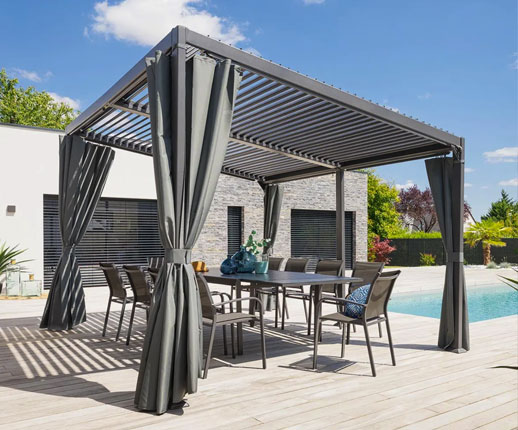
The application scope of the Outdoor Manual Pergola is extremely broad, covering virtually every scenario requiring outdoor shading, ventilation, and rain protection. In the residential sector, it is frequently utilized in private courtyards, villa terraces, balconies, and poolside areas. Beyond providing effective shade and protection, it allows users to control light and airflow by adjusting the angle of its louvers, ensuring the space remains comfortable under varying weather conditions. Furthermore, its modern design serves to enhance the overall aesthetic appeal and visual depth of the outdoor space.
In commercial settings, its applications are even more diverse. For instance, in the outdoor dining areas of restaurants and cafes, the pergola creates an excellent dining environment for patrons, liberating the outdoor space from weather constraints and thereby boosting seating utilization rates and operating hours. In hotels and resorts, it is often deployed in courtyards, pool areas, or relaxation zones to elevate the overall environmental quality and guest experience. In commercial districts or outdoor leisure plazas, it functions as a practical shading facility while simultaneously serving as a decorative architectural element.
Additionally, in various public and engineering projects—such as park rest areas, landscape developments, or outdoor exhibition spaces—the pergola can serve as a structural installation. It not only fulfills the practical requirements for shade and rain protection but also integrates seamlessly with the landscape design to enhance the overall aesthetic sophistication of the space. In summary, it is not merely a functional product but also a pivotal design element that significantly enhances the value of a space.
Core Competitive Advantages Compared to Electric Pergolas
Compared to electric pergolas, manual pergolas demonstrate distinct competitive advantages in several key areas. First is the aspect of cost: because they do not incorporate components such as motors, control systems, or remote modules, their overall manufacturing and procurement costs are lower. Typically, they offer savings of approximately 30% to 50% compared to their electric counterparts, making them a highly attractive option for projects with limited budgets or those prioritizing cost-effectiveness.
Second, regarding maintenance and reliability, manual structures are inherently simpler; lacking complex electrical systems, they mitigate the risks associated with motor failure, wiring degradation, or control system malfunctions. For outdoor environments, this structural simplicity naturally translates into superior stability and durability, making them particularly well-suited for long-term exposure to wind, rain, humidity, or significant temperature fluctuations. Furthermore, long-term maintenance is remarkably straightforward, typically requiring nothing more than periodic inspections of gears and connection points, followed by appropriate lubrication.
In terms of installation, manual pergolas also possess clear advantages. Since they require neither a power supply connection nor complex electrical wiring, the installation process is significantly simpler and imposes fewer constraints on site conditions. This makes them suitable for locations where power access is inconvenient or construction restrictions are prevalent—such as private courtyards, rural settings, or temporary commercial spaces.
From the perspective of market adaptability, manual pergolas enjoy broader global acceptance and are particularly competitive in markets that are cost-sensitive or possess underdeveloped infrastructure. Although they may not match the operational convenience of electric models (which offer features like remote or smart controls), their defining characteristics—simplicity, reliability, cost-efficiency, and independence from electrical power—ensure a consistently stable demand within the mid-range and mass markets.

 English
 中文简体
中文简体 +86-15067563447
 jenny@yoolo.com